A merchant cash advance puts money in the bank account within days and takes it back out of future sales. That speed is why owners take one. It is also why many owners sign a contract they have not priced. This guide explains how an advance works, how to work out what it really costs, the clauses that have caused trouble, and the disclosure laws that now apply in many states.
What a merchant cash advance is
A merchant cash advance (MCA) is not set up as a loan. A funder buys a share of the business's future sales at a discount. The business receives a lump sum and agrees to deliver a larger amount, the purchased sales, over time. The Federal Reserve's 2025 small business credit report says nonbank providers offer advances, usually for under $100,000, and that they are repaid as a percentage of sales or revenue rather than in fixed payment amounts.
Repayment comes in one of two ways:
- Card split. A fixed share of each day's card sales goes to the funder before the rest reaches the business. The card processor does the split, which is why an advance can be tied to your merchant account.
- Bank debit. The funder takes a fixed daily or weekly amount from the business bank account by ACH debit. Many contracts allow the amount to be adjusted if sales fall, but only when the owner asks and sends proof.
How to work out the real cost
Funders usually quote a factor rate, such as 1.35, rather than an interest rate. The Federal Reserve report makes the same point. A factor rate tells you the total to be paid back. It does not tell you the yearly cost.
Here is an example with round numbers:
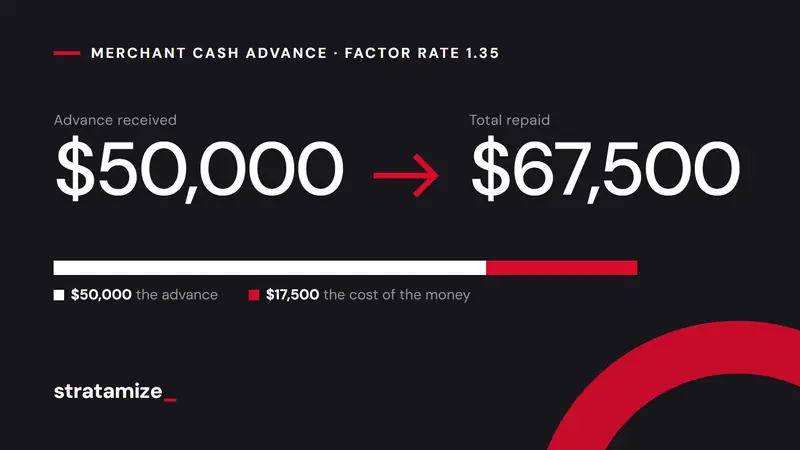
- Advance: $50,000
- Factor rate: 1.35
- Total to be repaid: $50,000 x 1.35 = $67,500
- Cost of the money: $17,500
That $17,500 looks like 35%, but it is not 35% a year. Suppose the purchased amount is collected over six months. The business is handing money back every day, so on average it has only about half the advance to use, and it pays $17,500 for that over half a year. The yearly cost works out far higher than 35%. Ask for the estimated annual percentage rate. In the states listed below, the funder has to give you a cost figure.
Check the amount you actually receive as well. Origination, underwriting and broker fees are often taken out of the advance. A $50,000 advance may put $47,500 in the bank while the full $67,500 is still owed.
The clauses to read twice
The Federal Trade Commission has sued MCA providers over the same handful of practices. The cases below are allegations and court findings about specific companies. They do not describe every funder, but they show where to look.
- The personal guarantee. In its 2020 complaint against RCG Advances, the FTC said the company advertised no personal guaranty while its contracts contained one. Its complaint against Yellowstone Capital made a similar allegation. It also said the company kept taking payments after contracts were paid off. Read who signs, and whether the owner is personally liable if the business stops paying.
- Confessions of judgment. A confession of judgment lets the funder get a court judgment without a lawsuit you can answer. In 2023 a court banned RCG's owner from the industry. The FTC said the confessions had been used to seize business and personal assets. New York restricted their use against out-of-state businesses in 2019.
- Fees not shown on the first page. The RCG complaint said fees were poorly disclosed or not disclosed at all. Ask for every fee as a dollar amount.
- The reconciliation clause. If sales drop, can the daily payment be lowered? How do you ask, and how quickly does the funder have to answer?
- Default and stacking terms. Many contracts treat a second advance from another funder, or a change of processor, as a default. Find out what triggers a default and what is owed if it happens.
In 2025 the New York Attorney General announced a settlement with Yellowstone. It cancelled more than $534 million owed by merchants, and the announcement called the products loans disguised as merchant cash advances.
Disclosure laws now cover many advances
A growing number of states require funders to show the cost of commercial financing before the deal closes. That includes sales-based financing such as MCAs. A March 2026 summary by Venable counts ten such states: California, Connecticut, Florida, Georgia, Kansas, Missouri, New York, Texas, Utah and Virginia.
- California. The DFPI's disclosure rules cover merchant cash advances. Funders must show the total funds provided, the total dollar cost, the term, the payment method and amount, and the prepayment policy. The business must sign the disclosures before the deal is finalized.
- New York. The Commercial Finance Disclosure Law requires sales-based financing providers to disclose the finance charge, an estimated annual percentage rate, the total repayment amount and the estimated term.
- Georgia. Georgia's commercial financing disclosure law took effect January 1, 2024 and covers transactions of $500,000 or less, according to Mayer Brown's summary. Providers must show the total funding, the amount actually paid out after fees, the total repayment and the payment schedule. Brokers may not charge advance fees.
- Texas. A 2025 law added disclosure and automatic-debit rules for sales-based financing. Providers and brokers must register with the state by December 31, 2026, according to Mayer Brown.
The rules differ between states on dollar thresholds and on whether an APR is required. If a funder will not give you the disclosure your state requires, treat that as your answer.
How to compare funders
Get at least two offers for the same amount, the same expected term and the same repayment method. Then compare them on four numbers:
- the cash that reaches your bank
- the total to be repaid
- the daily or weekly payment
- the estimated term
MCA Directory is a useful place to start. It is a searchable directory of merchant cash advance funders. You can filter by monthly revenue, credit score, industry and the number of advances a business already has, and it also has an MCA glossary and an underwriting calculator. Funders pay to be listed there. Use it to find and compare names, then judge each funder on its own contract.
Questions to ask any funder
- How much will actually reach the bank account after every fee?
- What is the total to be repaid, and what is the estimated annual percentage rate?
- Is the payment a share of card sales or a fixed bank debit, and how often is it taken?
- How is the payment adjusted if sales fall, and how long does that take?
- Is there a personal guarantee or a confession of judgment?
- What counts as a default? Is changing card processors one of them?
- Is there a discount for paying early?
Where Stratamize fits
Stratamize is an independent merchant services agent in Newnan, Georgia, and an independent referral partner for business funding. We are not a lender or a funder, and we do not make credit decisions. If you want help weighing an advance against a line of credit or a loan, read our business funding guide and apply for funding. We will say which kind of funding fits and what a funder will ask for. Every request is decided by the funder, on the funder's terms.
We also help with the card processing that an advance often runs through. Your processor collects a card-split advance, so a clean processing history and a merchant account in your own name make that kind of advance easier to set up. The statement showing your monthly card volume is also the first document most funders ask for.
Before you take on a daily payment, check what your card processing already costs. A lower effective rate on card sales keeps money in the business every day, with nothing to repay. Try our rate tool, read how a statement review works, or call (770) 629-0928 to go over your statement with our team.